
By Dr. Ray Makar, physician and USMLE tutor
Three months (about 12 weeks) is one of the most popular amounts of time to prepare for the MCAT. It is long enough to review all the content and take several full-length practice exams, but short enough to stay focused. This 3-month MCAT study plan works best for students who have finished their core science courses and can study about 4–6 hours a day (or 25–35 hours a week).
Before You Start: Three Steps
- Take a diagnostic test. Use a full-length practice exam (or a half-length one) to see your starting score and weak areas.
- Set your target score. Look at the average MCAT of the schools on your list. For most MD schools, aim for 510 or higher.
- Gather your materials. You need one set of content review books or videos, a question bank, and the official AAMC practice materials (the full-length exams and section banks). The AAMC materials are the closest to the real test.
The Plan at a Glance
| Phase | Weeks | Main goal |
|---|---|---|
| Phase 1: Content review | 1–6 | Learn and review all subjects; practice questions daily |
| Phase 2: Practice and fix weak areas | 7–10 | Full-length exams every week; review every mistake |
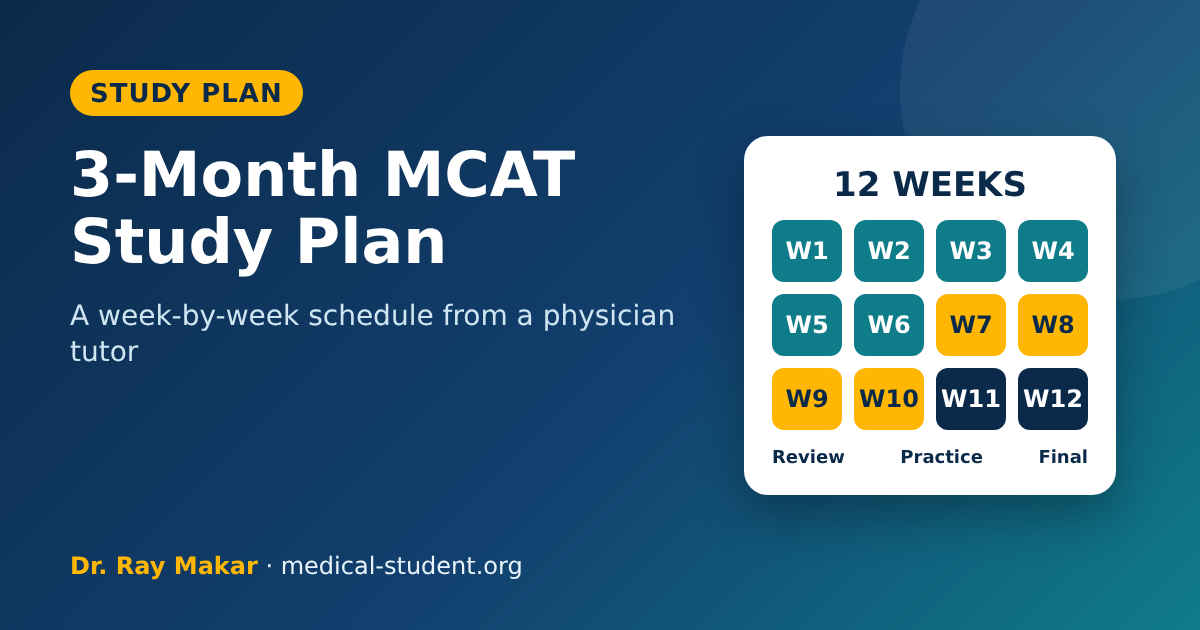
| Phase 3: Final review | 11–12 | AAMC full-lengths, light review, rest before test day |
Phase 1: Content Review (Weeks 1–6)
Each day: about 3 hours of content review, 1–2 hours of practice questions on the same topics, and 2–3 CARS passages. Keep one day each week lighter for review and rest.
| Week | Focus topics |
|---|---|
| 1 | Diagnostic test review; amino acids and proteins; enzymes and kinetics; general chemistry basics (atoms, bonds, stoichiometry) |
| 2 | Metabolism (glycolysis, Krebs cycle, electron transport chain); lipids and carbohydrates; physics: kinematics and forces |
| 3 | Molecular biology (DNA, RNA, gene expression); genetics; physics: work, energy, fluids |
| 4 | Cell biology; nervous and endocrine systems; organic chemistry (functional groups, reactions, separations); electricity and circuits |
| 5 | Cardiovascular, respiratory, renal, and digestive systems; acids and bases; thermodynamics and kinetics; light and sound |
| 6 | Psychology and sociology (all topics); immune, muscular, and reproductive systems; research methods and statistics. End the week with your second full-length exam. |
Tip: Psych/Soc is the section where content review gives the fastest score gain. Many students leave it for last and run out of time. Give it a full week.
Phase 2: Practice and Fix Weak Areas (Weeks 7–10)
Now you shift from learning to applying. Each week:
- Day 1: Take one full-length practice exam under real timing (about 7.5 hours with breaks).
- Days 2–3: Review the whole exam. For every wrong answer (and every lucky guess), write down why you missed it: content gap, misreading, or timing.
- Days 4–6: Study your weakest topics from that exam and do practice questions on them. Do CARS passages every day.
- Day 7: Rest or very light review.
Reviewing an exam is more important than taking it. Spend at least as much time reviewing as you spent testing.
Phase 3: Final Review (Weeks 11–12)
- Week 11: Take an official AAMC full-length exam early in the week. Review it carefully. Go over your “mistake notebook” and high-yield sheets (amino acids, metabolic pathways, key physics equations, psych/soc terms).
- Week 12: Take your last AAMC full-length no later than 5–7 days before the real test. After that, only light review. Do not try to learn new topics.
- Last 2 days: Rest. Confirm your test center and ID. Prepare snacks and water. Sleep well.
Sample Daily Schedule
| Time | Activity |
|---|---|
| 8:00–11:00 AM | Content review (main topic of the day) |
| 11:00–11:30 AM | Break |
| 11:30 AM–1:00 PM | Practice questions on the same topic |
| 1:00–2:00 PM | Lunch and rest |
| 2:00–3:00 PM | CARS: 3 passages plus review |
| 3:00–4:00 PM | Flashcards and review of mistakes |
Working or taking classes? Stretch the plan to 4–5 months at 15–20 hours a week, and keep the same order of phases.
Common Mistakes to Avoid
- Only reading, never practicing. The MCAT tests application. Do questions every day from week 1.
- Skipping CARS until the end. CARS improves slowly. Practice it daily.
- Taking full-lengths without reviewing them. A test you do not review teaches you very little.
- Ignoring sleep and exercise. Your memory needs sleep. Burnout costs more points than a missed study hour.
- Testing before you are ready. If your last practice scores are far below your target, think about moving your test date.
Frequently Asked Questions
Is 3 months enough to study for the MCAT?
For most students who have finished their science prerequisites and can study full-time or close to it, yes. If you work full-time or have big content gaps, plan for 4–6 months.
How many hours should I study for the MCAT?
Many successful students study a total of about 300–400 hours. In 3 months, that is roughly 25–35 hours a week.
How many practice exams should I take?
Aim for 6–8 full-length exams, including all of the official AAMC full-lengths.
When should I take the official AAMC practice tests?
Save them for the last 4–5 weeks, when you have finished content review. They are the best predictor of your real score.
The Bottom Line
A good 3-month MCAT study plan has three parts: learn the content (weeks 1–6), practice and fix weaknesses (weeks 7–10), and finish strong (weeks 11–12). Practice every day, review every mistake, and protect your sleep. Want to know what score to aim for? Read our guide: What Is a Good MCAT Score in 2026? And to see how your MCAT study pays off later, read MCAT vs USMLE Step 1: What Carries Over.
About the author: Dr. Ray Makar is a physician who practiced dermatology for 20 years and has tutored medical students and doctors for the USMLE for many years. He is the author of the “Repeated USMLE Questions” book series on Amazon.